
Is it a minor repair — or thousands of dollars you could’ve saved?
Knowing when to repair and when to replace can save your company thousands
— in money, time, and customer trust. Here’s how to make the call.
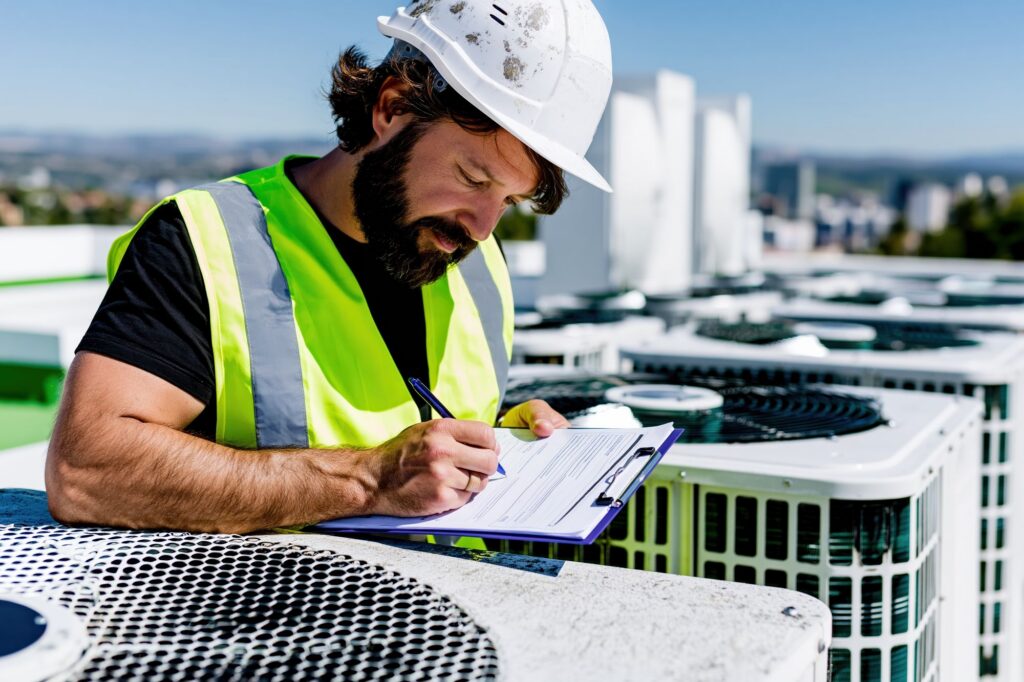
IN THE HVAC BUSINESS, one small fix can become a major hit to your budget later if it’s band-aided
instead of replaced when it needs to be. Approaching this sort of problem is difficult because many
people are reluctant to replace a “perfectly good” unit when they could repair it for 1⁄4 of the cost. But
a choice like that, made to keep extra money in the pocket, might lead to three more breakdowns that
year, costing not only money but time and potentially customers.
Learning when to make the call for an easy fix versus a replacement is necessary, especially when your
building depends on its HVAC units to uphold a safe workplace, happy customers, and an up-and-
running business.
The Age Threshold
Age sets the standard for every other decision that is made regarding HVAC repairs and replacements.
Under typical conditions, a commercial rooftop unit will usually give you 15 to 20 years of service.Other units, such as chillers and boilers, can last even longer if given proper attention and
maintenance over time.
A useful tool for discerning the age threshold of your HVAC unit is the ASHRAE HVAC Lifespan
Standards. The American Society of Heating, Refrigerating, and Air Conditioning Engineers
(ASHRAE) is a professional society that sets the rules and design guidelines for the HVAC industry.
The ASHRAE lifespan standards provide a data-backed baseline, factoring in the type of equipment
and history, that gives you a strong estimate of the remaining useful life of your equipment. If your
unit is performing below this point, replacement is typically the correct option, which the Cortez
mechanical team can easily carry out.
Why Florida Changes the Game
Understanding the age threshold of your HVAC unit can be critical when deciding whether or not it is
time to make a replacement. But beyond that, it is critical to evaluate the Florida-specific factors that
entirely change this threshold. Humidity, heat exposure, salt air corrosion, and more factors all play a
role in reducing the age threshold of HVAC units in the area.
Your AC systems are not just cooling the air, but they are drying it out. In Florida, the AC is pulling
water out of the air almost year-round. This creates an environment within the unit that fosters the
growth of mold and gunk. This can lead to clogs, leaks, water damage, and rotting metal, all of which
need immediate mechanical attention. This directly reduces the good years your unit has, and
depending on the unit, you must be aware of this condition when deciding whether it needs a fix or
replacement. These conditions vary depending on whether you live inland or on the coast.
Near the coast, the amount of salt air is abundant. This salt sticks to the metal, absorbs moisture, and
speeds up the rusting process of your HVAC unit. Salt has many negative impacts, and it can lead to
corrosion that causes your electrical parts to give out entirely. When evaluating your Florida-specific
age threshold, if you live further inland, a 12–15 year lifespan might be more realistic for your unit,
but as you move towards the coast, 8–12 years becomes the reality.
Understanding how environmental factors affect your unit’s age threshold is critical for saving your
company thousands in the long run. Consider adopting a maintenance agreement to catch any
damage or potential problems before they emerge. Our technicians are trained to maximize your
unit’s lifespan in the easiest and most financially beneficial way for you and your company.

The Math Behind the Decision
When evaluating the fix or exchange decision, one strategy is to use the 50% rule, a concept widely
used for this exact scenario. The way it works is simple: if a single repair would cost you 50% or more
of the price of a new, comparable system, you should replace the unit instead of paying for the fix.
This rule especially applies if the system has already used up 75% of its expected life, or if this system
has required multiple repairs in the last 24 months.
Other factors continue to come into play as well, such as the number of times the unit has already
needed a fix, and the expected lifespan after the fix. While this strategy has caveats and should be
considered alongside other information, it is a good starting point when evaluating the important fix
or replace decision.
Red Flags
Clear Signs It’s Time to Swap
- adjusted range (12–15 yrs inland, 8–12 on the coast)
- A single repair hits the 50% rule — half or more of the cost of a comparable new system
- Two or more repairs in the last 12 months, with costs still climbing
- Visible salt corrosion, rusted electrical parts, or recurring humidity, mold, and drain issues
- A documented efficiency drop pushing energy bills up despite normal use
Why Cortez Is the Obvious Call
The mechanics at Cortez aren’t just looking out for themselves. We pride ourselves on making our
customers feel like a larger part of the Cortez family, and the first step in that is making sure we are
making the right financial decisions for YOU and showing you the evidence behind it.
A documented service history predicts failure better than a single visit
Equipment failure shows up as a trend, not as a single event.
A tech who only shows up once sees a snapshot of the true situation. But if you have records over
time, you can catch repetitive issues and call for a replacement instead of paying for constant repairs
down the road. Cortez logs every visit and watches trends so you don’t have to, comparing them
against ASHRAE standards and ensuring that if your equipment shows any patterns of potential
failure, we will catch it early and prevent unnecessary repairs.
A lot of a unit’s real condition can’t be seen — it has to be measured
When evaluating whether your equipment needs repair or replacement, most of the time the largest
problems cannot be seen right away. That is why having experienced technicians check on your
equipment can be incredibly beneficial. While anyone can take a reading, Cortez has been interpreting
complex commercial systems for 60+ years, and we specialize in high-stakes equipment, like chillers,
cooling towers, and air handlers, where one wrong call means a shutdown, not just a service fee. We
carefully measure and document your equipment data so every visit is logged and accounted for, and
if there is a problem that can’t be seen to the naked eye, our technicians will find it and catch it before
it is too late.

Take the guesswork out of the decision
ASHRAE standards, the 50% rule, and Florida-specific factors can all be weighed together to make
the repair-or-replacement decision clear. Cortez is built on 60+ years of putting them into practice
— we use real data, log every visit, and never want to see a customer lose money over what they
thought was a simple repair. If you’re facing a tough decision or want to install a planned
maintenance program, reach out and you’ll no longer be facing it alone.
Latest Posts
Categories
Additional Reading
This is an example of large format copy. The width of this block has a max-width of 800px for increased readability. This is an example of large format copy. The width of this block has a max-width of 800px for increased readability.
Explore Our Other Services
Cortez covers the full range of commercial and industrial HVAC work, from the mechanical systems that keep a building cooled to the controls that keep it running efficiently.
Tell us about your building, and we’ll follow up with the next steps. For emergency support, skip the form and give us a call!
- Call for 24/7 Emergency Support:
- 866-755-5211
-
5012 US-41
Palmetto, FL 34221